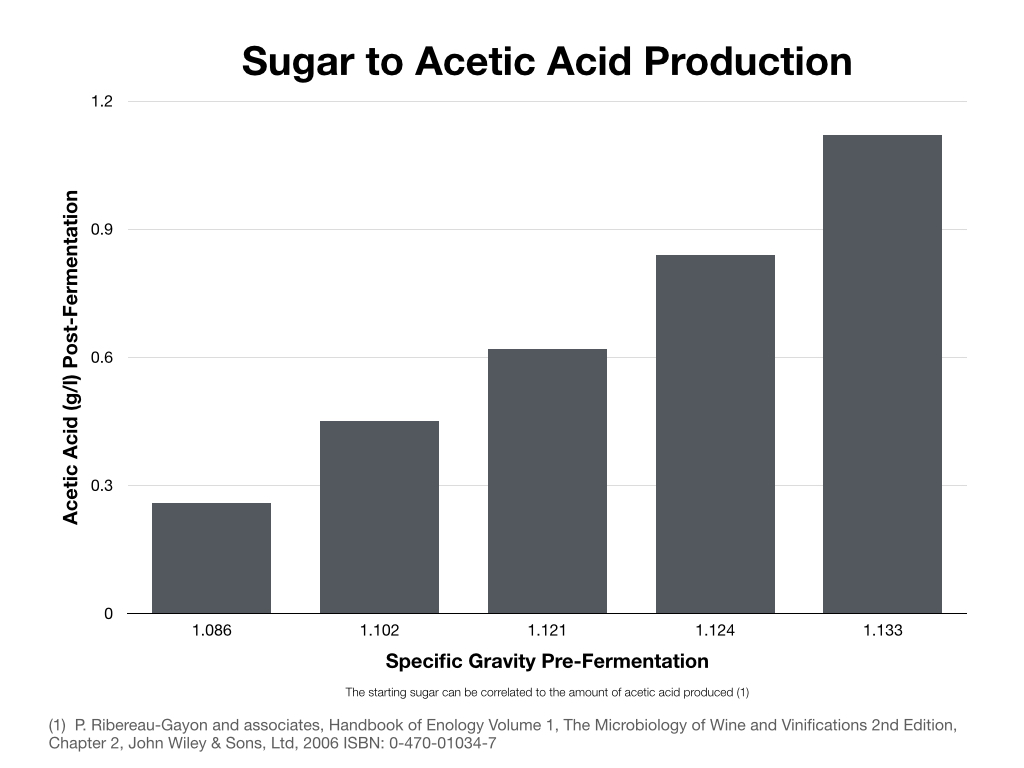
Did you know that the amount of sugar in your juice can impact the amount of acetic acid produced. As noted in the Handbook on Enology(1), wines with higher specific gravity produced more acetic acid when fermented with Saccharomyces cerevisiae yeasts. As shown in the above chart, a juice with a starting gravity of 1.086 produced only 0.26 g/l of acetic acid. This would produce a wine with about 11% ABV. A juice with a starting gravity of 1.133 produced over 4 times as much acetic acid. This juice would produce a wine with over 17% ABV.
Most of us don’t think that sugar will naturally create acetic acid, but that is how the environment of the yeast impacts the pathways that it will utilize. Sugar, even at the lower concentrations found in apple juice, is enough to prevent yeast from using respiration pathways even though these are more efficient at creating energy. This is true even in an environment where oxygen is readily available. As the level of sugar goes up, yeast have to find ways to keep themselves balanced in acidity, pH, and various compounds. When certain elements exceed the yeasts ability to survive, it either stops producing them or finds a pathways that will remove them. The creation of precursors and ultimately, acetic acid, is an example of how Saccharomyces cerevisiae yeast addresses an environment with too much sugar. This is different from how vinegar is formed, which is created by acetic acid bacteria oxidizing ethanol. That requires large amounts of oxygen in an environment rich in ethanol. This process is created by yeast during normal fermentation as a way to continue processing sugar, creating energy, and reproducing.
This is a great example of how wine and cider are different and how yeast used for making wine may not be the best yeast for making cider. At a minimum, it should give you pause when thinking about whether adding a lot of additional sugar is a good idea. The result won’t just be more alcohol, but a more acetic acid as well.
(1) P. Ribereau-Gayon and associates, Handbook of Enology Volume 1, The Microbiology of Wine and Vinifications 2nd Edition, Chapter 2, John Wiley & Sons, Ltd, 2006 ISBN: 0-470-01034-7
Check out some other interesting articles by Prickly Cider.


Don’t miss any future Mālus Trivium articles. Follow me and you will get a link to my latest article delivered to your inbox. It’s that easy!
Understanding how yeast create great cider will help you make better cider. Knowledge and sharing it is why I wrote my book, launched this website, and provide products and recommendations on The Shop page. It is why I started offering non-Saccharomyces yeast strains in the Cider Yeast section of the shop. If you are interested in supporting PricklyCider.com, check out the shop. As with everything, my goal even with the shop is to help you make better cider.
 PricklyCider.com
ginger
LikeLike