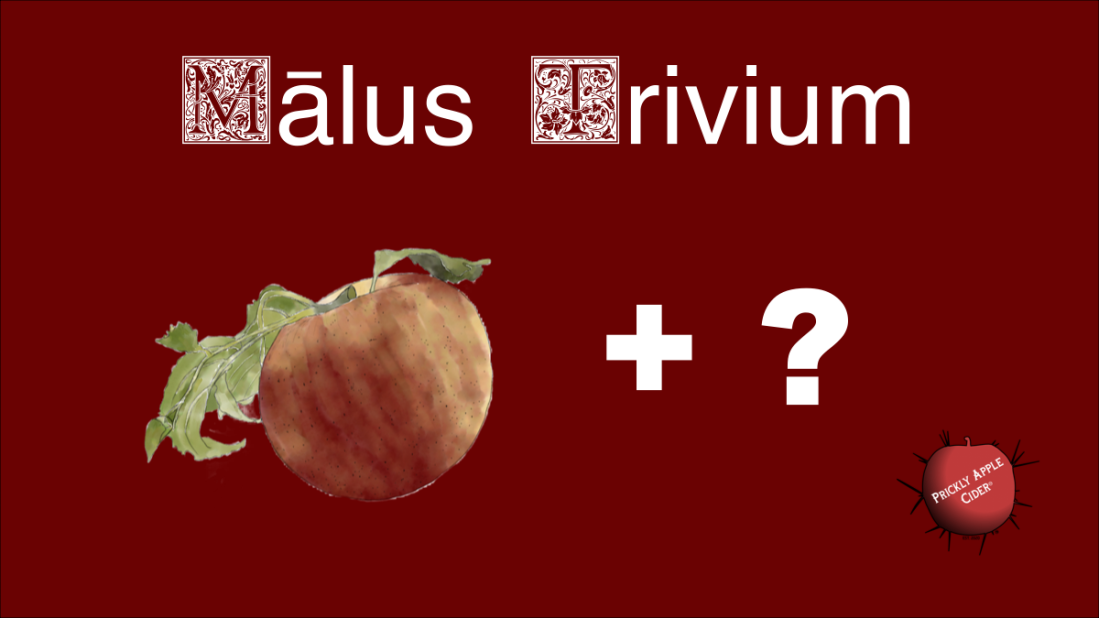
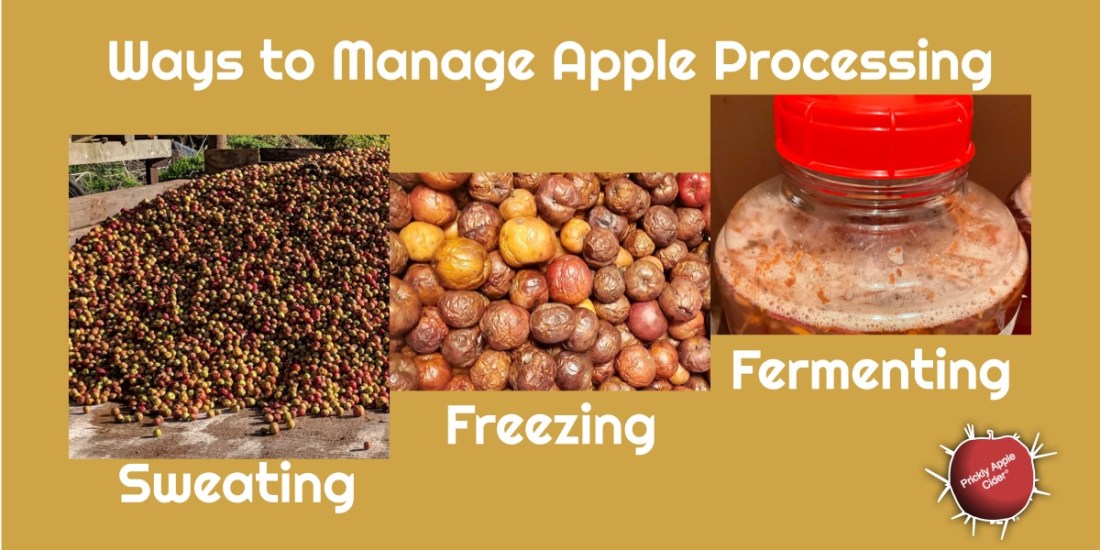
Things happen and you aren’t always able to process all the apples you need to fill your fermenter. For example, not all apples ripen at the same time. In fact, a single tree may take weeks to ripen all the apples on it. Maybe your grinder or press broke or you picked more apples than … Continue reading Cider Question: How can I delay processing my apples?
Tag: Sulfite
Cider Question: Can I use apples with worm holes?
If you are like me, you are interested in trying different apples but more importantly, you’re interested in cheap apples. Those may come from a backyard or roadside tree or even from an orchard. Often, they are damaged either from insects or weather, like hail. This inevitably leads to this week’s Cider Question about whether … Continue reading Cider Question: Can I use apples with worm holes?
Aroma Faults: Diacetyl
Cider Aroma Faults: Butter Sometimes too much of a compound is the cause of a fault. Other times, the definition of whether its a fault depends on the beverage. Diacetyl (C4H6O2) is an example of such a compound. In most beers, it’s considered a fault but, in most California chardonnays, it’s desired. Butter is the … Continue reading Aroma Faults: Diacetyl
Aroma Faults: Solvent
Cider Aroma Faults - Solvent or Vinegar Some compounds contribute positively, initially. But, if there is too much, they quickly become faults. Ethyl acetate (C5H8O2) is an example of such a compound. In low quantities, it can contribute to the aroma of a cider but in large quantities, it becomes a fault. It will turn … Continue reading Aroma Faults: Solvent
Aroma Faults: Rotten Eggs
Cider Aroma Faults: Rotten Eggs and Cooked Cabbage The smell of rotten eggs or cooked vegetables like cabbage or broccoli are two of the common sulfur (sulphur for my British friends) related odors faults that can be found in cider. The culprit is generally Hydrogen Sulfide (H2S), though other sulfur compounds like diethyl sulfide can … Continue reading Aroma Faults: Rotten Eggs
Cider Words: Natural Preservatives
Preservatives naturally found in hard cider Fermenting apple juice and making hard cider will naturally create compounds that act as preservatives. These compounds, like SO2 and CO2, can be added but, I am focusing on how these compounds are naturally created. The compounds are produced by lactic acid bacteria (LAB) and yeast in your juice … Continue reading Cider Words: Natural Preservatives
Cider Words: pH
Understanding pH to Make Better Cider Have you ever thought about what pH really means and why it might be important to cider making? Well you should. It is one of the key measurements that can help you make better hard cider. It’s also one if the easiest to measure since inexpensive and reasonably accurate … Continue reading Cider Words: pH
Sulfur Dioxide (SO2) Tolerance
Generalization of how tolerant various microorganisms are to free SO2. Sulfur dioxide (SO2) has the ability to weaken the cell walls of organisms resulting in their death or inability to function. It can also react and bind with phenolic and other compounds impacting color, sweetness, bitterness, and astringency. SO2 tolerance is the ability of an … Continue reading Sulfur Dioxide (SO2) Tolerance
Natural Preservatives: Killer Factors
Killer toxins to prevent Brettanomyces spoilage In my research on preservatives like Campden (potassium metabisulfite) and potassium sorbate that are commonly used in wine and cider to preserve the cider as well as prevent residual sugar from fermenting, I was always interested in finding alternative methods. Preserving hard cider is generally about stopping various bacteria … Continue reading Natural Preservatives: Killer Factors
Stop Killing Your Juice: The Argument Against Campden
Usually, my answer to a question about hard cider is “it depends”. I generally try not to be definitive because there are simply so many unknown factors that being definitive is almost always wrong. However, for this article, I’m going to argue a definitive. The definitive is that you should not use Campden tables in … Continue reading Stop Killing Your Juice: The Argument Against Campden