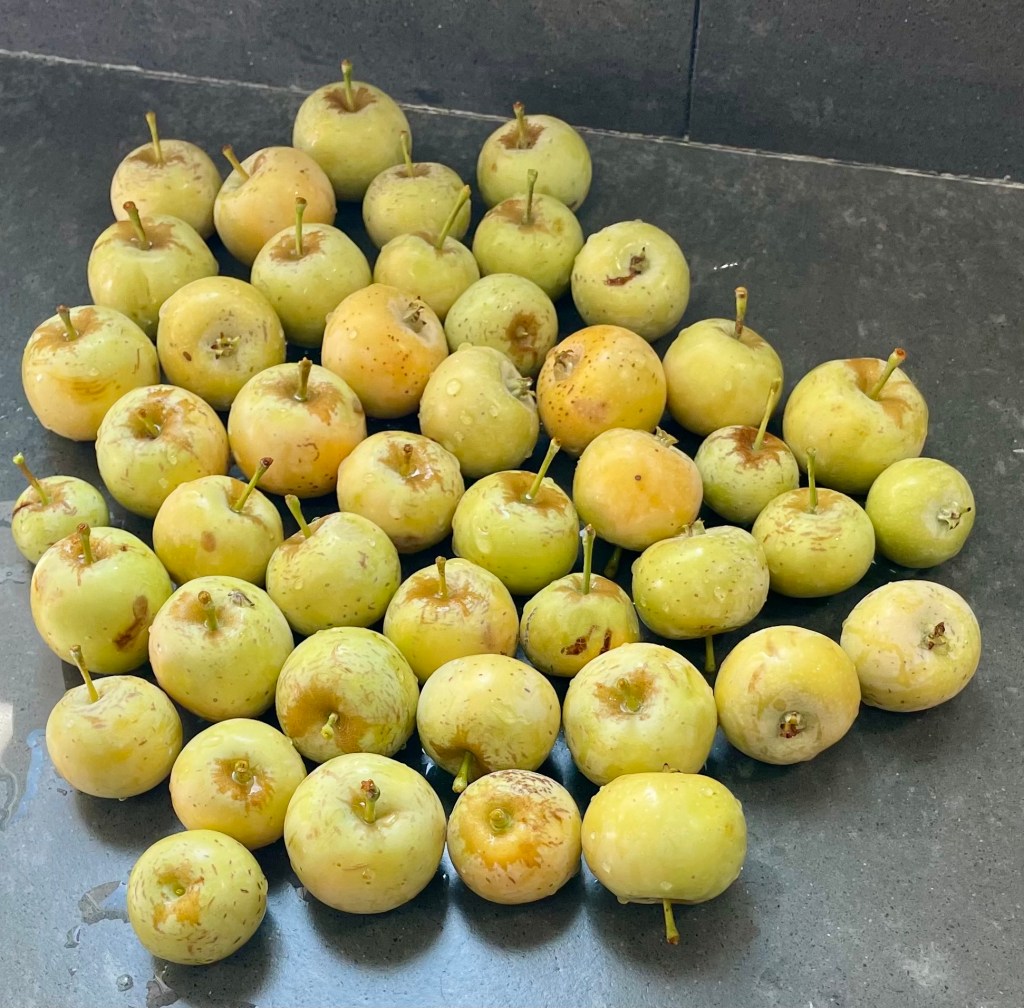
It is getting close to cider season for the Northern Hemisphere. I have actually begun harvesting the first batch of apples from my Hewe’s Crab. This is an American heirloom variety that normally ripens in early September. Besides being a nice bittersweet apple, it is also a great pollinator. Since it is mid-August, that means that either the desert climate in the Southwest causes them to ripen early or the record heat we had in mid-March pulled them forward. I have some pomegranates that are also ripening about a month early so it may just be the early record heat in March. Since this is my first year getting fruit from the orchard, I will have to see how the other trees ripen and monitor them next year to really know which factor is impacting the ripening cycle. I have not had much luck finding research data about growing cider apples in the Sonoran desert, so my little orchard is really an experiment. So far, the experiment seems to be working!
I also have two English cider apple trees that produced fruit this year. There is a Sweet Coppin and a Dabinett. Both of these are also bittersweet apples, which are what I lack in my area. I can find sweets and sharps but apples with good tannins are difficult to find in my area. In fact, these are actually the first English cider apples that I will have ever used. My Dabinett tree has the most fruit this year. The Sweet Coppin has several heavily laden branches but not the volume of the Hewe’s or Dabinett. I am hoping that I can collect enough fruit from all the trees to make 1-2 gallons of cider this year. That would make me very happy. The Sweet Coppin and Dabinett apples are still ripening based on pip color of some sampled fruit. They still need more time but I am getting excited to really have some cider apples for the 2026 Harvest Season
I am also excited to trial some new yeasts. This year, I will be propagating two new strains: Hanseniaspora valbyensis and Lachancea cidri. These are both yeast originally found in French ciders. This fits with my current research and focus for my upcoming book. I am seeking to better understand cider yeast and better define some guidelines for making cider. Hanseniaspora uvarum and Hanseniaspora valbyensis are of key interest as they have been reported to be the main yeast involved in keeved French ciders. They are both Crabtree negative yeast while Lachancea cidri is Crabtree positive. A Crabtree negative yeast like Hanseniaspora will actually respirate sugar as long as oxygen is present. This is different from Saccharomyces yeast used for beer and wine. These yeast are Crabtree positive, which means that even with oxygen, the respiration pathway to process sugar and create energy (ATP) is blocked. The sugar level shuts down the respiration pathway and forces the yeast to use the fermentation pathway. This is what makes the Hanseniaspora and many other non-Saccharomyces yeast interesting because they can produce lower alcohol and great aromas while preventing oxidation of the juice.
I am interested in adding these two new yeasts to my collection and offering them to others for trial. I had very positive result with last year’s two new yeast additions: Torulaspora microellipsoides and Metschinkowia pulcherrima. Torulaspora microellipsoides produced a very clear cider with a nice level of residual sugars using my new process. The Metschinowia pulcherrima showed why it is often used as a first stage yeast with wine makers. It is very quick to remove oxygen and prevent oxidative browning of phenolic compounds. It also produced residual sugars with a nice honey note to it.
It is not too early to order your yeast samples for this season. It will ensure you have them ready when your poles start dropping. If you give me time, I can also accommodate larger or custom orders from my yeast repository. Check out the Cider Yeast Shop for a list of options and you can always use the contact form to drop me a note if you need something special. Best of luck with this year’s harvest and as always, let me know if you have any questions or ideas you want to discuss. Here is the link to the contact page.
Here are some other posts you might find interesting.