Musing: I believe you are more likely to create sulfur odors adding yeast nutrients than preventing them. Let me explain.
The general belief is that sulfur aromas are created when yeast are stressed and lack nutrients, especially nitrogen. This is a true statement but, it’s also a statement about wine, not cider. Cider will generally have much lower sugar levels, which requires less nutrients. Apples tend to naturally have enough nitrogen to process all the available sugar. If you find your cider is producing sulfur aromas some yeast nutrient, DAP, can help mitigate its production. With cider, sulfur aromas coming from your fermenter are really a sign that you are using the wrong yeast or that you overfed your yeast.
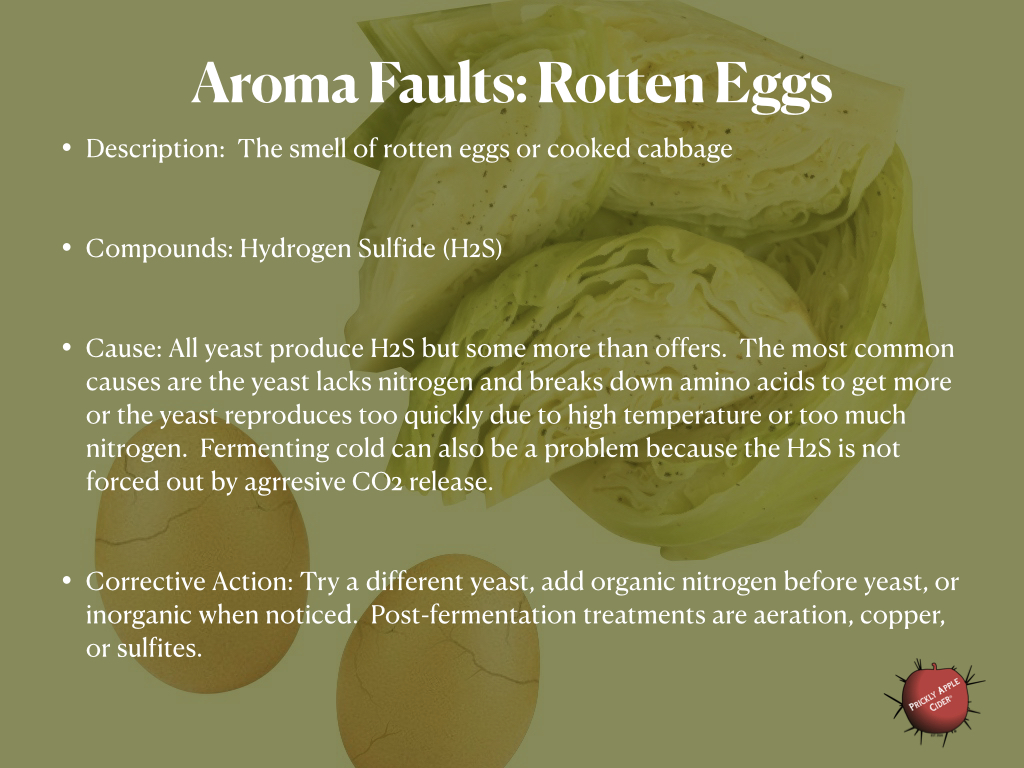
Yeasts have different genes, which make them unique. These genes define how yeast process various compounds and the yeast’s preference for those compounds. The methods yeast use to process these compounds are called pathways. Sulfur aromas are created through various pathways. One of those is when the yeast is lacking nitrogen needed to process sugar and reproduce. They breakdown various amino acids that can create hydrogen sulfide (H2S) or various mercaptans and disulfides that produce sulfur aromas. But, this risk is greatest with wine. Wine has high sugar levels and this high level requires a significant amount of nitrogen. Apple juice contains about half the sugar as grape juice and most apples have more than enough nitrogen to process this sugar. For cider, the risk of creating sulfur aromas is not lack of sufficient nitrogen but having too much inorganic nitrogen.
How would apple juice have too much inorganic nitrogen? The most common is because cider makers add “yeast nutrients”. Most yeast nutrients are actually diammonium phosphate, also called DAP. This is inorganic nitrogen and yeast generally love it. It is easily and quickly assimilated. It is the quick part that is the concern. Adding most yeast nutrient will generally make the yeast process sugar quickly. That leads to heat and that leads to sulfur aromas. Adding this type of yeast nutrient is usually a detriment to your cider. Not only does it create heat but fast fermentation means lots of CO2 is produced and released. That CO2 will remove volatile aromas. This is both good and bad as most sulfur aromas are volatile. But so are positive esters and other compounds.
Yeast nutrient is often recommended for wine because the sugar level is so much higher and yeast need the added nitrogen to process all the available sugar. But, cider is not wine. It doesn’t need the nutrient because the sugar level in apple juice is so much less than grape juice. You are more likely to cause problems by making the fermentation too fast creating heat and sulfur aromas. If you want to add some to be safe, consider organic nitrogen sources like Fermaid-O, which is derived from inactivated yeast. This nitrogen makes the yeast work to unlock the nitrogen and that process unlocks aroma and aroma precursor that can contribute positively to the aroma profile of your cider. Remember, hard cider is similar to beer and wine but it is not beer or wine. It is made from apple juice and you should strive to understand how the unique aspects of apple juice. The biggest is the lower level of simple sugars, which impacts the nutrients need and the microorganisms present in your cider.
Modern Hard Cider
What is modern hard cider? I think that’s a loaded question. It’s like asking someone what is a traditional hard cider, which will depend on your tradition. If you had asked me 6 month ago,…

Apples of Unknown Origin
I talked about how old some apple varieties really are (How old is that apple tree?). But America wasn’t settled using grafted apple trees from Europe. It was settled with apple trees grown from seeds…

Apple Sugars
While actual sugar levels vary by apple variety, weather, and orchard practices, the types of sugars as a percentage of total sugars are reasonably consistent. The majority is fructose followed by sucrose and glucose. The…
Did you enjoy these tips on making hard cider? Check out my book to learn more ideas and information on making and enjoying hard cider. It will help you develop a process that matches your desire and equipment. It will also show you how to pair cider with food to maximize your experience. You can find it as an eBook and a 7×10 paperback on Amazon or a 7×10 paperback on Barnes & Noble. Click on these Links to check them out.
 PricklyCider.com
Agree with much of what you say here. I think cider in North America would be better quality if made with this perspective in mind.
With sulfide-y, slow ferments I have had success with sub 10 ppm additions of DAP….with a fast fermentation though I doubt adding nitrogen addresses all problems.
LikeLike
14.50 a gallon !! Wow that’s pricey. I ask my local mill to hold cider gallons that are starting to wild ferment. And get them at a discount. Or even free if it’s a big farm. I know about the cider bug and got it good. I collected apples and pears this fall for free mostly , paid with fresh pressed to some. Got 7 five gallons glass carboys going and a conical.different yeasts and adjuncts. I even found a wild apple tree with bitter sweet apples. Yard sales,thrift stores, you can score cheap carboys. Check if you have a local brew/wine club where you can get stuff when people upgrade and shed there startup equipment. I got a fastferment free. There really is no right and wrong. Just make something you want to drink. Hey you could really cheat and just add some premium vodka to that expensive juice and call it ultra premium hard cider 🍸 cocktail. Want free apples ? check your local orchard and see if they will let you pick the dropped apples on the ground after they freeze. Which increases juice yield and you can skip the mashing step. As suggested on this site. Cheers
LikeLike
Dear Tom,
Greetings from Detroit! I’ve enjoyed reading your website over the last few months. I fermented my first cider in September from unpasteurized juice i got from the local cider mill. It wasn’t bad, though i didn’t know what i was doing, and i guess i still probably don’t. I guess my thing was first, just doing it as an experiment , and doing it as simply and cheaply as possible. But unpasteurized cider for $14.25 a gallon is not as cheap as possible. I then turned to Costco cider for $6, much cheaper. I used SafAle S-04 yeast for that first gallon, and two Costco gallons, one sulfited and one not, then experimented with some fancy yeast i bought online—have you ever used Opale 2.0? Had to buy 500 grams of it though! It’s funny how once you get started, you can’t stop! But all of these were just fermented for a few weeks, without an airlock. I wonder if i could put in some of the bacteria or yeast that covert malic acid to lactic acid and do it during primary fermentation. I’ve also just been using the original plastic jugs i buy the cider in, so i know I’m not really doing it right.
I’ve been working at the Detroit airport for the last two years or so as a gate agent, and just this afternoon had a Spanish couple from Basque country on my flight to Louisville. I told them i want to go there for the cider! And made a motion like i was trying to catch the cider coming from the keg, like i saw on the internet.
I’m sorry i missed out on your unconventional yeasts, i should have tried earlier. Say, are you moving to Brazil? I know in your book you had lived there before. I wonder if you’re ever going to start your own cider brewery? I figure with all your knowledge and experience, and passion, maybe you could really do a great job at your own cidery.
Well hey, if you ever pass through the Detroit airport, let me know!
Dave
LikeLike
Dave,
Your cider journey sounds awesome. I loved hearing some of your stories. I would encourage you to remember that there really is no right or wrong in the cider making process and experimenting is encouraged! Using the containers the juice comes in is a great way to repurpose and save money! I might have mentioned in my book that I lived in Detroit for 3 years and I know the airport well. I haven’t officially announced it yet for a few reasons but, yes, I am moving. The hint is that I’ll be close to the Basque region while leveraging the language skills I gained in Brazil. I’m currently in the middle of the process as I write this. More to come on that subject in the coming months!
I have not tried Opale 2.0. You will need to let me know how it works!
Thanks for reading, commenting, and supporting PricklyCider.com! It always makes my day.
Tom
LikeLike