You may have come across a recipe for making cider that calls for the addition of sugar or maybe you add sugar to your cider. The answer to the question of should you add sugar, varies. Fundamentally, you should never need to add sugar to make cider. In fact, in many countries, the addition of sugar can actually turn your cider into wine. The main impact of this is taxes that you’d pay if you were selling your product. For home cider makers, it’s more about the strength, the flavor, and the fizz. Let’s explore the three times when sugar is often added, why, and the impact it can have.
Pre-Fermentation:
Sugar is the main compound processed by yeast to make ethanol and carbon dioxide (CO2). The more sugar available, the more alcohol and CO2 that can potentially be created. I say potentially because ethanol is a toxin to yeast. Yeast will start to shutdown as ethanol levels exceed their tolerance. Most ripe apples will create a juice that has a specific gravity of at least 1.045. This means your cider will have at least 5.5% ABV using the common estimation method for cider. That is well within the normal range for cider. Each 2.6 grams per liter (9.9 grams per gallon) that you add will increase your specific gravity by 0.001 or about 0.13% ABV. Sugar is usually added to wine (chaptalization) in colder regions or when sun hours during the ripening period are reduced. If you are trying to increase your alcohol (i.e. make a wine), or create sweetness by making that yeast stall and creating residual sweetness, sugar can make that happen. Be warned, it won’t significantly improve the aroma and taste.
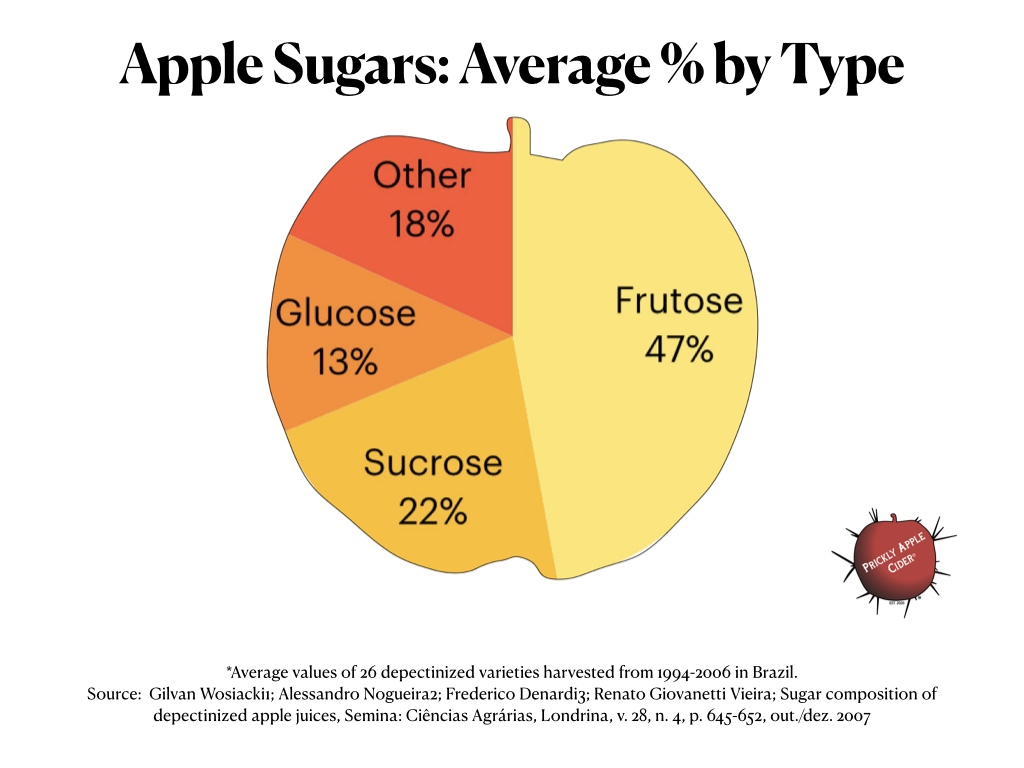
Fundamentally, glucose sugars don’t have any elements that directly contribute to positive aromas. It will create more alcohol, which could make ethanol the dominate aroma and taste of your cider/wine. If you want more ethanol and desirable aroma compounds, you have a couple good options. Concentrating your juice, like ice cider, is a more effective way to create higher alcoholic ciders with improved aromas and character. Adding honey and making a cyser, is another way to increase the alcohol and aroma. This happens because the concentrated juice has both concentrated sugars and aroma compounds. Honey is similar in that the sugar and pollen compounds are concentrated.
Aging
Another common time you might add sugar is during aging. Oxygen is generally undesirable during the aging of cider. If you lack a container that limits headspace, adding some sugar and keeping the container well sealed, except for an airlock device, is a possible way to prevent the exposure of oxygen through a large headspace area. The added sugar will ferment, using up any dissolved oxygen in the cider from racking and some of the oxygen in the headspace. It will also push out any remaining oxygen through the airlock. This should create a natural CO2 blanket that minimizes the oxygen during aging. Keep the cider at a constant temperature to prevent pullback through the airlock and keep the airlock full. You don’t need a lot of sugar. Each 2.6 grams per liter (9.9 grams per gallon) will create 0.6 volumes of CO2. That means your gallon (3.8L) carboy with just 9.9 grams of sugar will produce 0.6 gallons (2.3L) worth of CO2, which will fill the headspace. A little sugar will create a lot of CO2 and doesn’t create a lot of additional sediment or lees.
Bottling
Bottling is the other time sugar is often added to cider. This is because you want carbonation (CO2). As noted above, each 2.6 grams per liter (9.9 grams per gallon) will create 0.6 volumes of CO2. You need to remember that your cider will naturally have about 0.85 volumes CO2 already suspended in it from the fermentation process. This is the normal level it retains at room temperature (68F/20C) and atmospheric pressure (open container). Depending on how much carbonation, you desired, you can add more or less sugar. Sparkling is usually anything over 3.0 volumes CO2 and most beer bottles shouldn’t be above 3.5 volumes CO2. Even if you want a still cider, adding a very small amount of sugar can be beneficial. It will allow residual yeast to start fermenting again but it will utilize any oxygen added during the bottling process and help preserve the cider.
Should you add sugar? The answer depends on what your desired product will be. Sugar can be beneficial as a means to protect against oxygen exposure. It can also increase your level of alcohol. However, don’t expect it to improve the aromatic profile unless you are using an adjunct like honey.
(1) G Specht, Managing Wine Quality: Winemaking Technologies and Wine Quality, Chapter 1, Yeast fermentation management for improved wine quality, Woodhead Publishing Limited, 2010
Don’t miss any future answers to Cider Questions. Follow me and you will get a link to my latest article delivered to your inbox. It’s that easy!


 PricklyCider.com